
23 Oct NeuroStar TMS in Minnesota: Why Not All TMS Is the Same
If you’ve been living with depression that hasn’t gotten better on medication, you may have heard about TMS (transcranial magnetic stimulation). It’s a non-drug, non-invasive treatment that uses magnetic pulses to stimulate the area of the brain involved in mood. You stay awake the whole time, there’s no sedation, and you can drive yourself home and get back to your day. At Sonder, we offer NeuroStar TMS to patients across Minnesota.
As TMS has grown more popular, more clinics and more machines have entered the field. That’s good news for access — but it also means patients are often left wondering: Is all TMS basically the same?
The short answer is no. The device, the coil, the way your dose is measured, and the way each session is monitored all shape the care you receive. So does the clinic delivering it. Here’s what to know about both — and why Sonder chose NeuroStar Advanced Therapy for our patients.
The first, and the most studied
NeuroStar was the first TMS system cleared by the FDA to treat depression, back in 2008. In the years since, it has built the deepest track record in the field. NeuroStar has been used in more than 7.6 million treatments, and its maker, Neuronetics, reports that it is backed by the largest clinical data set of any TMS system for depression — including the world’s largest depression outcomes registry.
Why does that matter to you? More data means physicians have a clearer picture of who responds, how quickly, and how long results last. According to Neuronetics, NeuroStar is the only TMS treatment clinically shown to be effective through 12 months in patients with treatment-resistant depression.
A more precise way to treat
The part of a TMS machine that does the work is the coil — the padded piece that rests gently against your head during treatment. Not every machine uses the same kind of coil.
NeuroStar’s coil is designed to focus treatment on the specific area of the brain linked to mood. The same coil is also used for every condition NeuroStar treats — depression, depression with anxiety, OCD, and depression in teens — so your treatment plan can change as your needs do, without new equipment.
Making sure every session counts
TMS works best when every session is delivered the same way — in the right spot, at the right strength, for several weeks. NeuroStar has built-in tools to help with that:
- It notices if something shifts. If you move or the coil loses contact, NeuroStar alerts your treater right away so it can be fixed. According to NeuroStar’s maker, no other TMS system has this feature.
- Your dose is personalized. At your first visit, your provider uses NeuroStar’s tools to find the right treatment strength for you.
- Same spot, every time. A guided positioning system helps your treater place the coil in the same spot at every visit.
- Your progress is tracked. Each session is securely recorded so your care team can see how you’re doing over time.
What does NeuroStar TMS feel like?
For many people, not knowing what to expect is the hardest part. Here’s what a typical session is like:
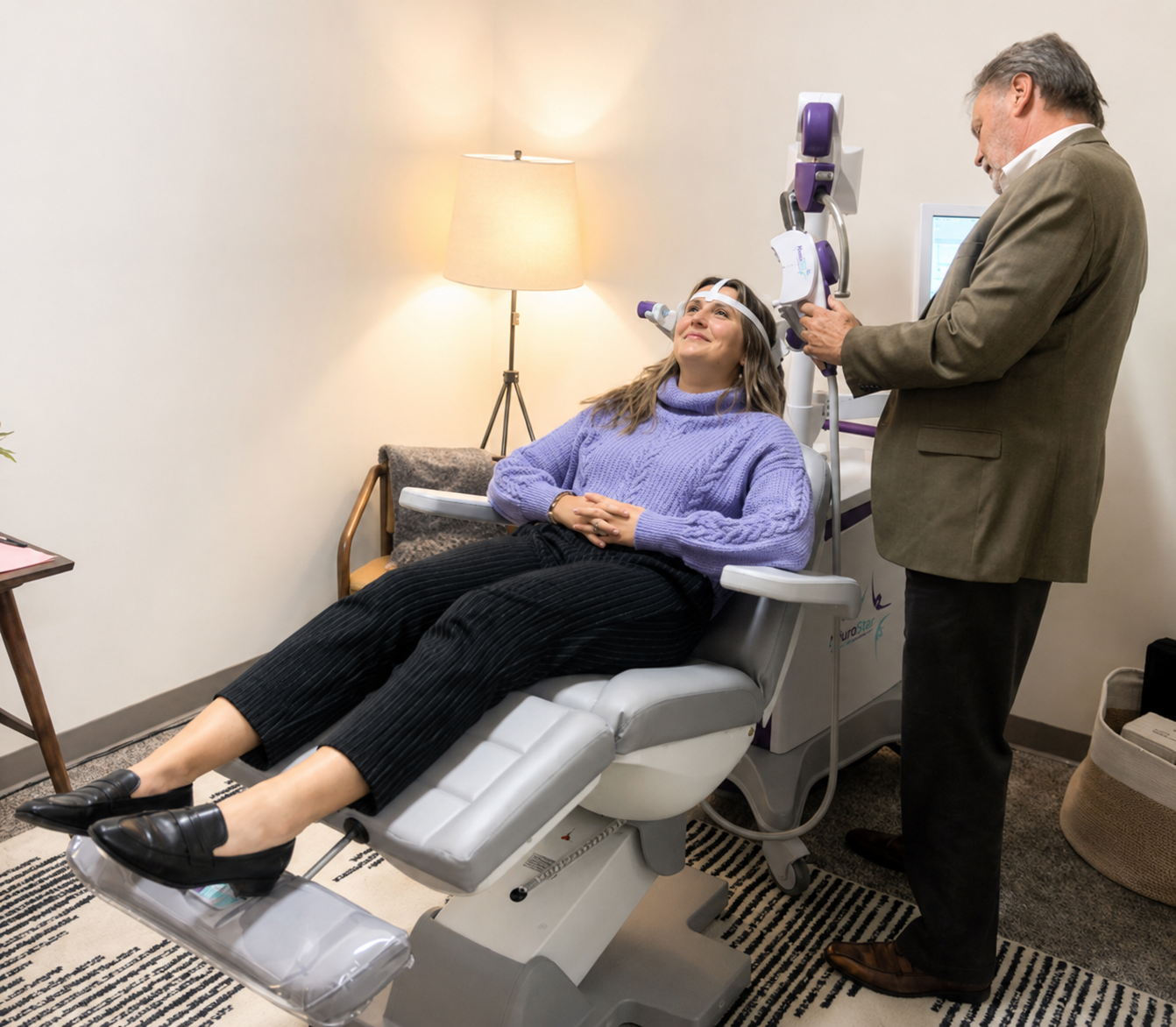
- You’re awake and comfortable. You sit in a reclining treatment chair, and the coil rests gently against your head. No needles, no sedation.
- You’ll hear and feel tapping. During treatment, the coil makes a clicking sound and you’ll feel a tapping sensation on your scalp. Ear protection is provided.
- Any discomfort usually fades quickly. The most common side effect is mild discomfort at the treatment spot, which typically goes away after the first week.
- You go right back to your day. You can drive yourself home, head to work, or pick up the kids afterward.
In our patients’ words:
“The staff helped calm me and explain certain things I had questions/concerns about. But, then the treatments started becoming relaxing.”
“The treatment was painless and easy.”
Trusted by physicians and insurers
NeuroStar describes itself as the #1 physician-recommended TMS treatment, and it’s the leading TMS treatment for adult depression in the U.S. It’s also widely covered: most major commercial and government health plans cover NeuroStar for patients who qualify. In 2026, Optum/UnitedHealthcare expanded its policy so psychiatric nurse practitioners can order, supervise, and administer NeuroStar treatment — another sign of how established it has become.
NeuroStar was also the first TMS system FDA-cleared as an add-on treatment for adolescents ages 15–21 with depression, a decision based in part on real-world outcomes data collected through NeuroStar’s own registry.
Why Sonder is Minnesota’s #1 NeuroStar TMS provider
Before bringing TMS to our patients, Sonder’s team did its own research into the TMS systems available. We chose NeuroStar, and we’ve worked closely with the NeuroStar team ever since. Today, Sonder is Minnesota’s #1 NeuroStar TMS provider, with more than 20,000 TMS treatments delivered.
For you, that means a care team with deep, hands-on experience with this exact system, backed by a close working relationship with the company that makes it. Because NeuroStar delivers new treatment protocols through software updates, our patients also benefit as the technology advances — without waiting on new equipment.
Questions to ask any TMS provider
Whether you choose NeuroStar TMS at Sonder or another provider in Minnesota, you deserve to understand your treatment. Here are a few good questions to bring to a consultation:
- Which TMS system do you use, and is it FDA-cleared for my condition?
- How do you determine my treatment dose?
- How do you make sure the coil stays in the right place and in contact during every session?
- Who supervises my treatment, and how is my progress tracked?
- Will my insurance cover treatment on this system?
We’d add one more: If TMS isn’t the right fit for me, what else can you offer? At Sonder, we’re happy to walk through every one of these questions with you.
Comprehensive care, not a TMS-only clinic
TMS clinics have been opening quickly, and many of them offer just one thing: TMS. That model has a built-in limit — a clinic that only offers TMS can only recommend TMS.
Sonder is different. We’re a full behavioral health practice, and TMS is one of several tools we use. That changes your care in a few important ways:
- We recommend TMS only when it’s right for you. Your consultation starts with your whole history and goals, not a single treatment. If something else is a better fit, we’ll tell you — and we can provide it.
- TMS works alongside the rest of your care. Many patients do best when TMS is paired with therapy and thoughtful medication management. At Sonder, all of that happens under one roof, with providers who work together on your plan.
- More options when you need them. Beyond TMS, we offer Spravato® for treatment-resistant depression, along with ongoing therapy and medication management.
- Care that continues after your last session. A TMS course lasts a few weeks. Your mental health care doesn’t end when it does — our team stays with you for follow-up, maintenance, and whatever comes next.
The whole experience matters
TMS means showing up most weekdays for several weeks, so where you go and who you see matters just as much as the technology.
- Treaters chosen with care. Our TMS treaters are handpicked, and you’ll see them at nearly every session. Patients often tell us their treater became an unexpected favorite part of their TMS journey.
- A space designed to help you relax. Our treatment environment is intentionally calm and soothing — a place you can actually look forward to coming to.
- Doctors who take time with you. Our physicians are personable and approachable, and they’re part of your care from your first consultation through your final session.
“The treatment team was very encouraging and friendly.”
“All the staff treated me with kindness and respect. The TMS techs are awesome. Once I started feeling results, I was excited to go every day.”
Working with your care team — here or anywhere
If you already see a therapist or psychiatrist at Sonder, your TMS care fits right into the rest of your treatment, and we’ve got you covered after TMS ends.
Already have providers outside Sonder? That’s great, too. We’re happy to work directly with your outside therapist or psychiatrist to coordinate your care during and after TMS, so you don’t have to start over or choose between the people who already know you.
Faster relief: Sonder’s Accelerated TMS program
Standard TMS typically takes four to six weeks. For patients who need relief sooner, Sonder offers its own five-day, physician-led Accelerated TMS program for people ages 15 and older with major depressive disorder.
- Multiple short sessions per day. Each session lasts about three and a half minutes, with six to eight sessions a day over five consecutive days.
- Targeting based on your anatomy. Our protocol uses a proven F3 mapping technique to find your treatment location — no complex brain imaging required.
- Backed by our own research. In Sonder’s pilot study, published in the journal Brain Stimulation, about 70% of participants showed a meaningful response to treatment.
- A private, supportive setting. Patients receive treatment in a private suite with continuous psychiatric oversight and a dedicated care coordinator. Travel packages with lodging and transportation are available for patients coming from outside the area.
Some insurance carriers are beginning to cover Accelerated TMS, though not all do yet. Our team will check your coverage for you, and financing is available through CareCredit. Standard TMS is covered by most insurance plans. Learn more about Accelerated TMS at Sonder.
What our patients say
Numbers tell part of the story. Our patients tell the rest:
“Around the end of week three, beginning of week 4, I noticed my mood lifting a bit. I remember driving home from TMS one day and quite joyfully singing along with the radio. I couldn’t remember the last time I’d done that.”
“My family noticed the changes before I did.”
“I’m no longer depressed and I just landed a job after 5 years of disability. I’m very excited to live a full life again!”
Watch a Sonder patient share their NeuroStar TMS story (CLICK HERE)
Individual results vary. Read more TMS stories from Sonder patients.
The right treatment, in the right place
TMS has given many people a real path forward after medications haven’t been enough. But the technology is only part of the story. The system you’re treated on, the people delivering your care, and the support around you all shape how you feel along the way — and what happens after.
At Sonder, we bring those pieces together: NeuroStar TMS, the most established system in the field; a Minnesota team that knows it inside and out; and comprehensive care that starts with what you need, not with a single treatment. Whether TMS turns out to be the right fit or something else is, you won’t have to figure it out alone.
If you’ve been wondering whether NeuroStar TMS could help, a conversation with our Minnesota team is a good place to start.
Ready to learn more? Visit https://sonderwellness.com/tms-therapy-for-depression/ to learn more or to schedule a NeuroStar TMS consultation at one of our Minnesota clinics in Minnetonka, Medina, and Oakdale.
Important safety information
Adult Indications for Use: The NeuroStar Advanced Therapy System is indicated for the treatment of depressive episodes and for decreasing anxiety symptoms for those who may exhibit comorbid anxiety symptoms in adult patients suffering from Major Depressive Disorder (MDD) and who failed to achieve satisfactory improvement from previous antidepressant medication treatment in the current episode. The NeuroStar Advanced Therapy System is intended to be used as an adjunct for the treatment of adult patients suffering from Obsessive-Compulsive Disorder (OCD).
Adolescent Indications for Use: NeuroStar Advanced Therapy is indicated as an adjunct for the treatment of Major Depressive Disorder (MDD) in adolescent patients (15–21).
NeuroStar Advanced Therapy is only available by prescription. A doctor can help decide if NeuroStar Advanced Therapy is right for you. The most common side effect is pain or discomfort at or near the treatment site. These events are transient; they occur during the TMS treatment course and do not occur for most patients after the first week of treatment. There is a rare risk of seizure associated with the use of TMS therapy (<0.1% per patient). NeuroStar Advanced Therapy should not be used with patients who have non-removable conductive metal in or near the head. Visit neurostar.com for full safety and prescribing information.
This article is for general education and is not medical advice. Statistics and product claims are as reported by Neuronetics, Inc., maker of NeuroStar.